Feathers vs. Firepower: How Australia's Military Lost a War Against Birds
When Birds Became Public Enemy Number One
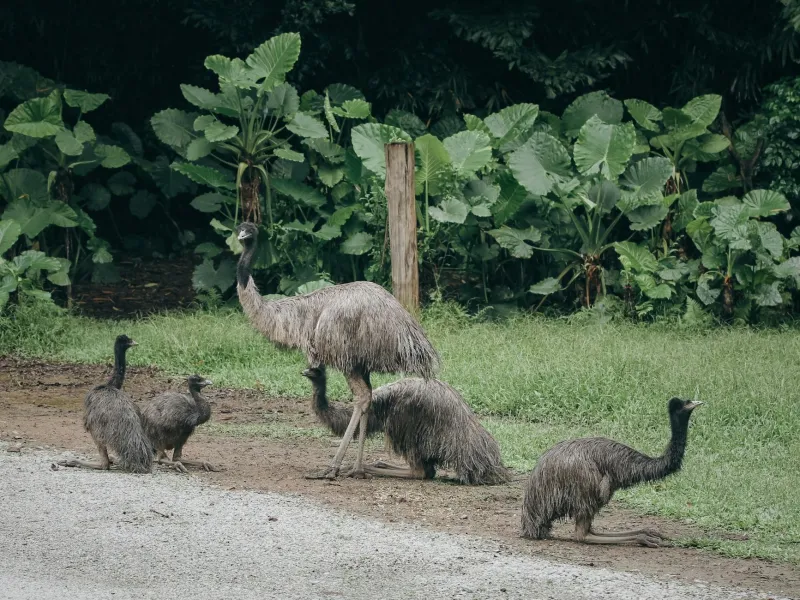
Picture this: It's 1932, and the Australian government is about to authorize military action against an enemy that threatens national agriculture and economic stability. Soldiers are deployed with Lewis machine guns, ammunition, and strict orders to eliminate the threat. The enemy? Twenty thousand emus with attitude problems and an apparent death wish for wheat crops.
What sounds like the setup for a Monty Python sketch actually happened, and somehow, the birds won.
The Feathered Invasion That Started It All
After World War I, the Australian government had encouraged veterans to take up farming in Western Australia's wheat belt. By 1932, these farmers faced a double catastrophe: the Great Depression had crashed wheat prices, and an estimated 20,000 emus had decided their carefully cultivated fields made excellent all-you-can-eat buffets.
These weren't your average backyard birds. Emus stand six feet tall, weigh up to 130 pounds, and can sprint at 30 miles per hour. When they descended on the wheat fields in massive flocks, they didn't just eat the crops—they trampled fences, destroyed infrastructure, and left behind a trail of agricultural devastation that would make a tornado jealous.
The farmers' situation grew so desperate that they petitioned the government for military assistance. Amazingly, the government said yes.
Operation Emu: Australia's Strangest Military Campaign
On November 2, 1932, Major G.P.W. Meredith of the Royal Australian Artillery arrived in Campion, Western Australia, with two soldiers, two Lewis machine guns, and 10,000 rounds of ammunition. Their mission: wage systematic warfare against the emu population.
The plan seemed foolproof. Emus might be large, but they were just birds facing military-grade weaponry operated by trained soldiers. How hard could it be?
Very hard, as it turned out.
The Birds Fight Back (Sort Of)
The first engagement revealed the fundamental flaw in Australia's anti-emu strategy. When the soldiers encountered their first flock, the birds didn't panic and flee in terror like any sensible creature should when facing machine gun fire. Instead, they scattered into smaller, faster-moving groups that proved nearly impossible to target effectively.
Major Meredith quickly discovered that emus possessed an almost supernatural ability to absorb bullets without dying. The birds' loose feathers and tough hide meant that shots that should have been fatal often just bounced off or failed to hit vital organs. Even when hit multiple times, many emus simply kept running.
One particularly frustrating encounter saw the soldiers fire repeatedly at a flock, only to watch the birds regroup and continue their agricultural rampage elsewhere. The emus had inadvertently developed guerrilla warfare tactics.
Military Tactics Meet Avian Chaos
As the days wore on, the absurdity of the situation became increasingly apparent. The soldiers tried mounting their machine guns on trucks to improve mobility and firepower, but the rough terrain and the birds' unpredictable movement patterns made accurate shooting nearly impossible.
In one memorable incident, the military convoy became separated from their targets entirely when the truck broke down. Another time, they managed to corner a large flock, only to have the birds split into dozens of smaller groups that scattered across miles of countryside.
The emus seemed to develop an almost supernatural awareness of the soldiers' presence. They would appear in one location, disappear when the military arrived, then resurface somewhere completely different to continue their crop destruction.
The Embarrassing Truth About Casualties
After several days of intense "combat," the military's success rate was embarrassingly low. Despite firing thousands of rounds, they had killed fewer than 50 emus—a kill rate that made the birds statistically more likely to die of old age than military action.
Meanwhile, the emu population seemed largely unaffected by the assault. They continued eating crops, breaking fences, and generally behaving like they owned the place. Which, from their perspective, they probably did.
The farmers who had requested military assistance watched in growing horror as their supposed salvation turned into an expensive demonstration of human incompetence against bird psychology.
Strategic Withdrawal and Political Fallout
By November 8, 1932, Major Meredith made the decision that would cement this episode in history: he officially withdrew his forces, effectively surrendering to the emus.
The political consequences were swift and merciless. Opposition politicians seized on the military's failure, asking pointed questions in Parliament about how the nation's armed forces could be defeated by flightless birds. Newspaper headlines mocked the government's "war on wildlife," and the story became an international embarrassment.
One member of Parliament sarcastically suggested that the emus should be awarded medals for their outstanding performance against organized military forces.
The Legacy of Australia's Most Unusual Defeat
The Great Emu War remains one of history's most bizarre military campaigns, proving that sometimes the most unexpected opponents can achieve the most unlikely victories. The emus' success wasn't due to superior strategy or advanced weaponry—they simply existed in ways that made conventional military tactics completely ineffective.
The farmers eventually found more practical solutions to their emu problem, including better fencing and bounty systems that proved far more effective than machine guns. But the story of how Australia's military lost a war to birds became a permanent fixture in the nation's folklore.
Today, the Great Emu War serves as a reminder that reality often produces stories stranger than fiction. Sometimes the most powerful military in the region really can be outsmarted by creatures whose primary tactical advantage is being too scattered and resilient to defeat efficiently.
The emus, for their part, never officially signed a peace treaty. Technically, they might still be winning.