The Numbers Don't Lie (Except When They Do)
In the summer of 1920, census enumerator Harold Wickham faced a problem that would seem laughably simple by today's standards: he couldn't read his own handwriting. After weeks of trudging through the rural farmland surrounding Picher's Hollow, Missouri, counting families and recording their information by hand, Wickham had accumulated a notebook full of increasingly illegible scrawl.
As he prepared to submit his final count to the Census Bureau, Wickham made what he thought was a minor clerical correction. He changed a "3" that looked like an "8" back to a "3," adjusted a few other questionable numbers, and submitted his tally. What he didn't realize was that his "corrections" had just transformed a sleepy farming community of 312 people into a bustling town of 10,847 residents—a mathematical miracle that would trigger one of the most expensive bureaucratic comedy of errors in American history.
When Washington Took Notice
The 1920 Census results landed on federal desks like a bombshell. According to Wickham's numbers, Picher's Hollow had experienced the most dramatic population boom in Missouri history, growing by over 3,000% in a single decade. Federal officials were astounded but not suspicious—after all, the 1920s were boom times for many American communities, and rural-to-urban migration was creating instant cities across the Midwest.
What happened next was a masterclass in bureaucratic momentum. Federal agencies, armed with Wickham's inflated population figures, began calculating Picher's Hollow's share of various infrastructure programs. A community of nearly 11,000 people clearly needed improved roads, expanded postal service, a larger school system, and modern utilities. The money began flowing almost immediately.
By 1922, Picher's Hollow was receiving federal funding calculated for a population thirty-five times its actual size. And because 1920s bureaucracy moved slowly and communicated poorly between departments, nobody thought to double-check the numbers that seemed too good to be true.
Building an Empire of Air
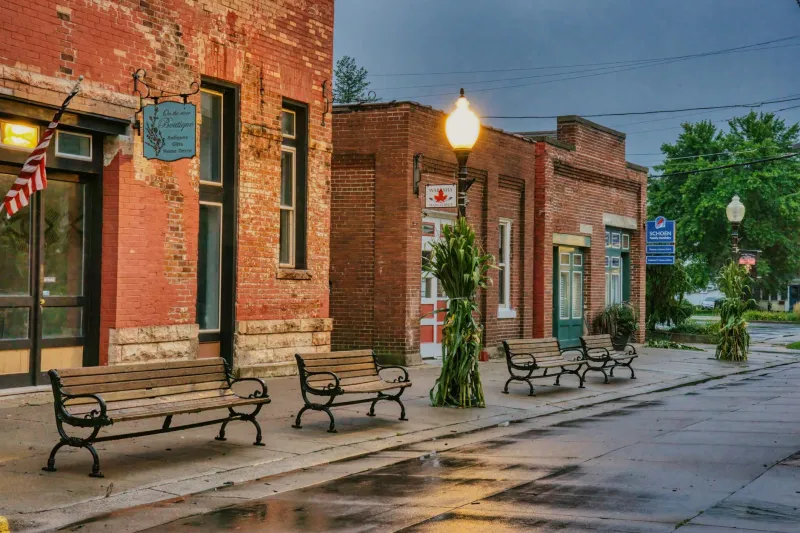
The first sign that something was amiss should have been the road construction. Federal highway planners, working from Wickham's population data, designed a network of paved roads capable of handling traffic from a major regional hub. Construction crews arrived in Picher's Hollow expecting to find a bustling town center and instead discovered a collection of farmhouses scattered across several square miles of prairie.
But government contracts are government contracts, and the roads got built anyway. By 1924, Picher's Hollow boasted some of the finest paved highways in rural Missouri—four-lane thoroughfares that connected wheat fields to more wheat fields, with traffic levels that barely justified a dirt path.
The postal service expansion was even more surreal. Based on the phantom population, Picher's Hollow received approval for three post offices, two mail sorting facilities, and daily delivery service to residential routes that existed only on paper. Postal workers found themselves delivering mail to addresses that consisted of empty fields, while maintaining facilities designed to serve thousands of residents who had never existed.
The School That Taught Nobody
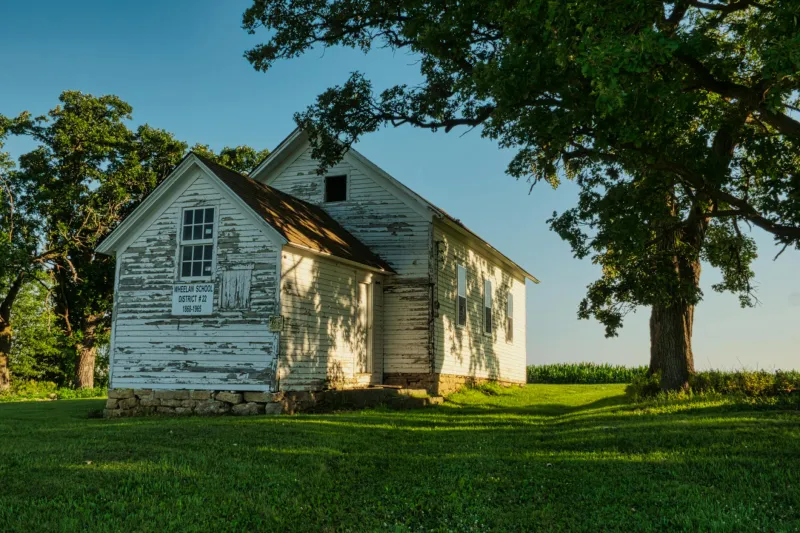
Perhaps the most poignant symbol of the census error was the Picher's Hollow Consolidated School, a magnificent brick building completed in 1925 with funding for a student body of 2,000. The structure featured twenty-four classrooms, a full gymnasium, a cafeteria designed to serve 500 meals daily, and administrative offices for a staff of dozens.
On opening day, fourteen students showed up—the entire school-age population of the actual community. They rattled around the enormous building like marbles in a cathedral, attended by a principal and three teachers who had been hired to educate hundreds of children who existed only in Harold Wickham's illegible notebook.
Local residents, initially bewildered by the sudden federal attention, gradually adapted to their infrastructure windfall. Farmers used the oversized highways to transport grain more efficiently. The unused classrooms in the massive school became community meeting spaces and storage areas. The extra post offices, while unnecessary, provided jobs for local residents who were happy to sort mail for their phantom neighbors.
The Audit That Changed Everything
The census error might have continued indefinitely if not for the 1930 Census, which revealed Picher's Hollow's population to be exactly 287 people—a decline that would have represented one of the most catastrophic demographic collapses in American history. Census officials, finally suspicious, launched an investigation that quickly uncovered Wickham's decade-old mistake.
The revelation triggered a federal audit that took two years to complete and revealed the staggering scope of the error's consequences. Between 1920 and 1930, Picher's Hollow had received over $2.3 million in federal infrastructure funding—roughly $35 million in today's money—based entirely on Harold Wickham's inability to read his own handwriting.
The Bureaucratic Scramble
Federal officials faced an unprecedented dilemma: what do you do with infrastructure built for people who don't exist? The roads couldn't be removed, the school was already built, and the postal facilities were operational. More importantly, the real residents of Picher's Hollow had grown accustomed to their accidental windfall and weren't eager to give it up.
The solution was typically bureaucratic: officials quietly adjusted future funding allocations to account for the error while allowing existing infrastructure to remain in place. Picher's Hollow kept its oversized school, its magnificent highways, and its surplus of postal services, but federal agencies began using more rigorous verification procedures for census data.
The Ghost Infrastructure Legacy
Today, nearly a century later, traces of Harold Wickham's counting error are still visible across what is now called Picher (the "Hollow" was dropped in the 1940s). The community of roughly 300 people still attends events in their enormous school building, now used primarily as a community center. The oversized highways, while no longer quite as impressive by modern standards, continue to serve local farmers and the occasional confused tourist who wonders why such elaborate roads exist in the middle of nowhere.
The post offices were eventually consolidated, but the main facility—built for a city-sized population—still serves the community and surrounding farms. Local residents joke that they have the most efficient mail service in rural Missouri, a legacy of the federal government's attempt to serve 10,000 phantom neighbors.
The Human Side of Numbers
The Picher's Hollow census error represents more than just bureaucratic incompetence—it illustrates the very human reality behind the statistics that shape American policy. Harold Wickham wasn't trying to defraud the government; he was a hardworking enumerator trying to make sense of his own illegible notes. Federal officials weren't being careless; they were processing thousands of population reports and had no reason to suspect that one small Missouri town was reporting impossible numbers.
The story also highlights the remarkable adaptability of both bureaucratic systems and small communities. When faced with infrastructure designed for a population thirty-five times larger than reality, Picher's Hollow residents found creative ways to use their accidental windfall. And when federal officials discovered the error, they chose pragmatism over punishment, allowing the community to keep the benefits of a mistake nobody had intended to make.
The Numbers Game
In an era when data drives policy decisions and algorithms determine resource allocation, the Picher's Hollow census error serves as a reminder that behind every statistic is a human being with a pencil, trying to make sense of an often confusing world. Harold Wickham's illegible handwriting created a decade-long federal funding program for people who didn't exist, but it also provided real benefits to a community that might otherwise have been overlooked by federal planners.
Sometimes the most important infrastructure in America gets built for all the wrong reasons—and sometimes that works out just fine.