The Post Office That Refused to Die
In 1962, Ethel Morrison locked the door of Glenwood, North Dakota's post office for the last time, loaded her belongings into a pickup truck, and drove away. She was the town's final resident, the end of a story that had begun with such promise in 1903. What she didn't know was that she was also the beginning of an entirely different story—one that would cost taxpayers hundreds of thousands of dollars and expose a fundamental flaw in how America keeps track of its own geography.
 Photo: Ethel Morrison, via www.ccparkboard.com
 Photo: Glenwood, North Dakota, via townmapsusa.com
For the next three decades, Glenwood continued to exist in the eyes of the federal government. Mail was delivered to empty buildings. Infrastructure grants were approved for roads leading to nowhere. Rural development funds flowed to a town that consisted of nothing but wind, weeds, and a surprisingly persistent zip code.
When Reality and Paperwork Diverge
Glenwood's ghost life began with the best of bureaucratic intentions. The town had been struggling since the 1940s, when mechanized farming reduced the need for rural labor and young people started migrating to cities. By 1960, only three families remained. By 1962, only Ethel Morrison was left, serving as postmaster, mayor, and essentially the entire municipal government.
When Morrison finally gave up and moved to Fargo, she dutifully filed paperwork with the postal service to close the post office. She notified the county clerk that the town council was dissolving. She even sent a letter to the state capital explaining that Glenwood no longer had any residents.
What she didn't do—because nobody told her she needed to—was navigate the labyrinthine process of officially "unincorporating" a municipality in federal records. That oversight would prove expensive.
The Bureaucratic Hydra
Here's where things get wonderfully absurd. Glenwood existed in at least seventeen different federal databases, from the Census Bureau to the Department of Agriculture to the Federal Highway Administration. Each agency maintained its own records, updated at different intervals, with different criteria for determining whether a place qualified for various programs.
The post office closure was noted by the Postal Service but not automatically shared with other agencies. The Census Bureau, which only conducted full counts every ten years, wouldn't discover Glenwood's abandonment until 1970—and even then, the information took years to filter through to other departments.
Meanwhile, Glenwood's zip code remained active. Mail addressed to the town was forwarded to a regional processing center, then returned to sender with a "forwarding address unknown" stamp. But the system interpreted this as a temporary service disruption, not evidence that the entire town had vanished.
The Money Keeps Flowing
By the late 1960s, Glenwood was receiving rural development grants intended to help small communities modernize their infrastructure. The Department of Agriculture approved funding for road improvements in 1968. The Department of Health, Education, and Welfare allocated money for a community center in 1971. The Federal Highway Administration budgeted funds for traffic signs in 1974.
None of these agencies bothered to verify that Glenwood still existed before cutting checks. The money was sent to the county government, which was supposed to oversee the projects. County officials, overwhelmed with managing dozens of small towns and assuming the federal government knew what it was doing, simply deposited the checks and filed the paperwork.
"We figured if Washington was sending money to Glenwood, there must be a good reason," recalled former county administrator James Peterson in a 1995 interview. "It wasn't our job to question federal funding decisions."
The Phantom Infrastructure Projects
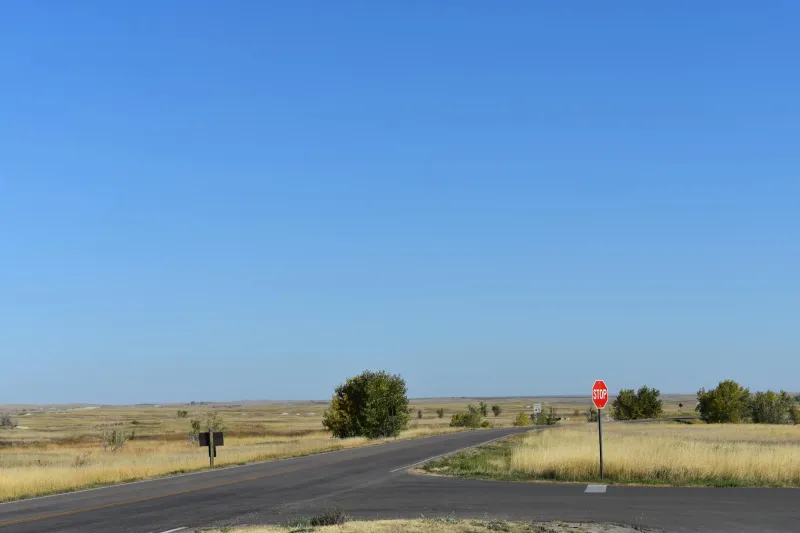
The most surreal aspect of Glenwood's paper existence was that some of the funded projects actually got completed. Road crews, following work orders and GPS coordinates, paved sections of highway leading to the abandoned town. A contractor built a small bridge over a creek that ran through what had once been Main Street. Warning signs were installed at railroad crossings that hadn't seen a train since 1958.
The result was a perfectly maintained ghost town, complete with fresh asphalt, new signage, and a bridge to nowhere. Occasional hunters and hikers stumbled across these improvements and wondered why the government was maintaining infrastructure for a place that clearly hadn't been inhabited in decades.
The Audit That Changed Everything
Glenwood's fictional existence might have continued indefinitely if not for a routine audit conducted by the Government Accountability Office in 1992. The GAO was investigating rural development spending and noticed some unusual patterns in North Dakota's funding allocation.
Auditor Sarah Chen was assigned to visit several small communities that had received significant federal investment. Glenwood was on her list, having collected over $340,000 in various grants since 1965.
Chen's first clue that something was wrong came when her GPS led her to a cluster of abandoned buildings surrounded by inexplicably well-maintained roads. Her second clue was the complete absence of any human activity. Her third clue was the historical marker, erected by the state in 1976, that described Glenwood as a "former agricultural community" that had been "abandoned in the 1960s."
"I stood there looking at this sign about an abandoned town while holding paperwork showing it had received federal funding just six months earlier," Chen later wrote in her audit report. "It was like discovering the government had been sending welfare checks to a cemetery."
Unraveling the Paper Trail
Chen's investigation revealed the full scope of the bureaucratic breakdown. Glenwood appeared in federal databases under three different spellings, with two different zip codes, and was classified as both "rural community" and "unincorporated area" depending on which agency you asked.
The town had received funding for projects ranging from road maintenance to senior citizen services (for a population of zero seniors). It had been included in congressional district maps, emergency response plans, and agricultural surveys. The Census Bureau had been estimating its population using statistical models that assumed gradual growth, projecting that Glenwood would have 47 residents by the year 2000.
Most embarrassingly, Glenwood had been featured in a 1989 Department of Agriculture report titled "Success Stories in Rural Development" as an example of how federal investment could revitalize small communities.
The Cleanup Operation
Removing Glenwood from federal records proved almost as complicated as the original oversight. The GAO identified 23 different databases that needed updating, requiring coordination between 11 federal agencies and four congressional offices.
The process took three years and cost an estimated $127,000 in administrative time—money that could have funded actual infrastructure improvements in communities that still existed. Several agencies initially resisted removing Glenwood from their records, arguing that the town might be "temporarily depopulated" and could theoretically be reoccupied in the future.
The debate over Glenwood's official status became so contentious that it required intervention from the Office of Management and Budget, which issued a directive in 1995 establishing clearer protocols for determining when a place stops being a place.
The Legacy of a Town That Wasn't
Today, the site of Glenwood is marked only by a few foundation stones and those oddly pristine roads that lead to empty fields. The federal funding debacle led to reforms requiring agencies to cross-reference population data before approving rural development grants, potentially preventing similar oversights.
But Glenwood's story raises deeper questions about how America defines and tracks its own communities. In an age of increasing automation and data sharing, the possibility of phantom places persisting in government databases seems both more unlikely and more dangerous.
The Moral of an Empty Story
Perhaps the strangest aspect of the Glenwood affair is how long it took anyone to notice. For thirty years, the federal government maintained detailed records about a place that existed only in filing cabinets, funded infrastructure for residents who had been gone since the Kennedy administration, and planned services for a community that had returned to prairie grass.
The final cost of Glenwood's paper existence—including fraudulent grants, administrative cleanup, and process reforms—exceeded $600,000. That's roughly $12,000 for every year the town didn't exist, or about $200,000 for each of the three families who had actually lived there during its final years.
Ethel Morrison, the town's last resident, died in 1988, four years before anyone discovered that her old home was still receiving government attention. She never knew that her decision to lock up and leave had accidentally created one of the most expensive clerical errors in federal history.
Somewhere in North Dakota, fresh asphalt still marks the roads to nowhere that were Glenwood's final, unintended gift to American bureaucracy—a reminder that sometimes the most persistent places are the ones that exist only on paper.