When American Optimism Meets Geographic Reality
In the annals of American municipal history, few stories capture the frontier spirit quite like Riverside, Missouri — the only incorporated town in U.S. history whose city hall was legally located at the bottom of a river.
Founded in 1857 by ambitious settlers armed with faulty maps and unshakeable confidence, Riverside existed for six remarkable years as a fully functioning municipality despite the minor inconvenience that its official town center was permanently underwater. The town elected mayors, collected taxes, issued permits, and conducted business with the kind of practical determination that could only flourish in 19th-century America.
It was democracy with a distinct aquatic flavor.
The Map That Launched a Thousand Headaches
The story begins with the Kansas City, Fort Scott & Memphis Railroad's ambitious expansion plans in the 1850s. Railroad companies were crisscrossing Missouri, establishing depot towns every ten to fifteen miles along their routes. Each new settlement represented potential profits from land sales, shipping fees, and the general economic activity that followed railroad development.
When the railroad commissioned surveyor Jonathan Wickham to plat a new town along the Osage River in Benton County, they provided him with what they claimed were the most current topographical maps available. Unfortunately, these maps had been drawn in 1834, before a series of floods had significantly altered the Osage River's course.
Wickham, working from his office in Kansas City rather than visiting the actual site, dutifully laid out a perfect grid pattern for the new settlement. His survey showed Main Street running east-west along what the map indicated was a low ridge overlooking the river. The town square was positioned at the intersection of Main and River Streets, with the courthouse and city hall planned for the most prominent lots.
The survey was filed with the state in Jefferson City, lots were advertised for sale, and settlers began arriving to claim their pieces of the American dream.
The Wet Welcome
The first hint that something was amiss came when early settlers arrived to find their "ridge overlooking the river" was actually three feet underwater.
The Osage River had changed course sometime in the 1840s, cutting a new channel directly through what Wickham's survey had designated as the town's commercial district. The planned location of city hall sat beneath four feet of slow-moving river water, while Main Street existed only as an underwater thoroughfare occasionally navigated by confused fish.
"My great-great-grandfather was one of the first to arrive," recalls local historian Dorothy Mae Collins, whose family archives include letters from Riverside's early days. "He wrote to his brother back in Ohio saying he'd bought a lot with 'excellent water access' but hadn't expected quite that much water access."
A lesser group of pioneers might have packed up and left. But these were people who'd traveled hundreds of miles based on railroad company promises and surveyor drawings. They'd invested their life savings in Riverside lots and weren't about to let a little geographical inconvenience derail their plans.
Democracy Adapts to Circumstances
By late 1857, about forty families had settled in and around Riverside, building their homes and businesses on whatever dry land they could find near their legally designated lots. The town's geography bore no resemblance to Wickham's survey, but the legal boundaries remained unchanged.
This created a unique situation: Riverside existed simultaneously as a physical community built on solid ground and as a legal entity whose official boundaries included a significant portion of the Osage River.
Rather than challenge the survey or relocate, the settlers decided to work within the system. In November 1857, they held their first municipal election, choosing Samuel Hartwell as mayor and electing a five-member city council. The election was held at Murphy's General Store, since the legally designated polling place was underwater.
"They were remarkably practical about the whole thing," explains Missouri legal historian Dr. Patricia Brennan. "The attitude seemed to be, 'Well, this is where we are, so this is where we'll govern.'"
The Floating City Hall Solution
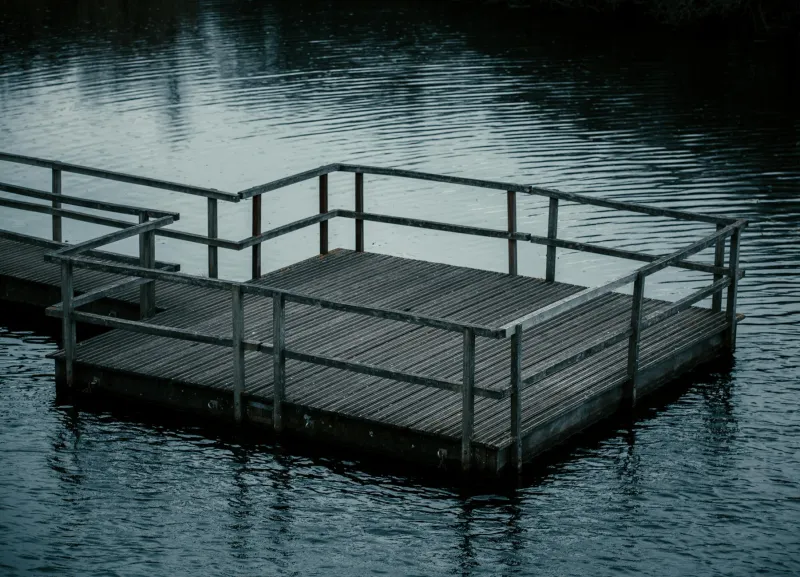
Mayor Hartwell's first official act was addressing the city hall problem. Since the designated location was permanently submerged, the council voted to construct a floating platform anchored above the legally correct coordinates.
The "city hall" was essentially a large wooden raft with a small cabin that could be moved up and down the river depending on water levels and weather conditions. During council meetings, members would row out to the platform, conduct their business, and row back to shore.
"It was probably the most democratic government in American history," jokes Brennan. "Every council meeting required genuine cooperation just to get everyone in the same place."
The floating city hall served multiple purposes beyond municipal governance. Local fishermen used it as a launching point for their boats. During summer months, it became an unofficial swimming platform for local children. And during the winter of 1859-60, when the river froze solid, it served as the foundation for Riverside's only ice skating rink.
Taxation Without Representation (of Dry Land)
Riverside's unique geography created fascinating challenges for municipal administration. Property taxes were assessed based on Wickham's original survey, meaning some residents paid taxes on land that was technically underwater while others owned dry land that didn't officially exist.
The city council developed creative solutions to these problems. Underwater lots were assessed at reduced rates, with the discount varying by depth and current strength. Property owners whose actual buildings sat outside the official town boundaries were allowed to pay voluntary taxes in exchange for municipal services.
"The tax rolls from Riverside are absolutely fascinating," notes Dr. Brennan. "You'll see entries like 'Johnson lot — 50% submerged, assess accordingly' right next to 'Miller store — built on non-existent lot, voluntary contribution basis.'"
The system worked surprisingly well. Riverside consistently met its financial obligations to Benton County and even managed to fund small infrastructure projects like a ferry service and a wooden sidewalk system that connected the scattered buildings on dry ground.
Life in a Liquid Municipality
For six years, Riverside functioned as a normal frontier town that happened to have an unusual relationship with water. The community supported two general stores, a blacksmith shop, a small hotel, and Murphy's Saloon, which served as the unofficial town hall for meetings too large for the floating platform.
Children attended school in a one-room building constructed on the highest available ground, about a quarter-mile from where the survey said the school should be located. The post office operated out of a converted chicken coop that technically sat outside the town boundaries but within the service area.
Residents developed a unique civic pride around their aquatic governance. When officials from other Missouri towns visited, Riverside citizens would proudly row them out to the floating city hall and explain their innovative approach to municipal administration.
"There's a certain frontier logic to it," observes Collins. "These people had figured out how to make democracy work despite impossible circumstances. They were proud of that achievement."
The End of an Era
Riverside's experiment in amphibious governance came to an end in 1863, not because of the water problem but because of the Civil War. Missouri's location as a border state made it a hotbed of guerrilla warfare, and small towns like Riverside became difficult to defend.
Most residents evacuated by early 1863, with many families relocating to larger, more secure communities. The floating city hall was abandoned and eventually broke apart during spring floods. By 1864, Riverside existed only on paper — official incorporation documents filed away in Jefferson City.
The town was never formally dissolved, creating another bureaucratic oddity. Technically, Riverside, Missouri still exists as a legal entity, though its boundaries now encompass only river water and the occasional sandbar.
Legacy of a Liquid Democracy
Today, the site of Riverside is marked by a small historical marker on Highway 65, about two miles from where the actual town was built. The Osage River has shifted course again since the 1850s, and the current riverbed bears little resemblance to either Wickham's survey or the community that once thrived there.
But Riverside's legacy extends beyond its brief existence. The town's creative solutions to bureaucratic problems influenced Missouri municipal law, particularly regarding surveying disputes and boundary corrections. Several legal precedents established during Riverside's existence are still cited in property law cases today.
"Riverside represents something uniquely American," reflects Dr. Brennan. "It's the idea that if the system doesn't work perfectly, you adapt the system rather than abandoning your goals. These people wanted to build a town, so they built a town — even if it meant holding city council meetings on a raft."
The floating city hall may be long gone, but its spirit lives on in the American tradition of making democracy work, regardless of the circumstances. After all, if you can govern a town that's half underwater, regular municipal administration should be a breeze.
Sometimes the most profound civic lessons come from the most improbable places — even if that place happens to be in the middle of a river.