The Mop That Almost Ended Modern Medicine: How a Lab's Cleaning Schedule Nearly Killed Penicillin Before It Started
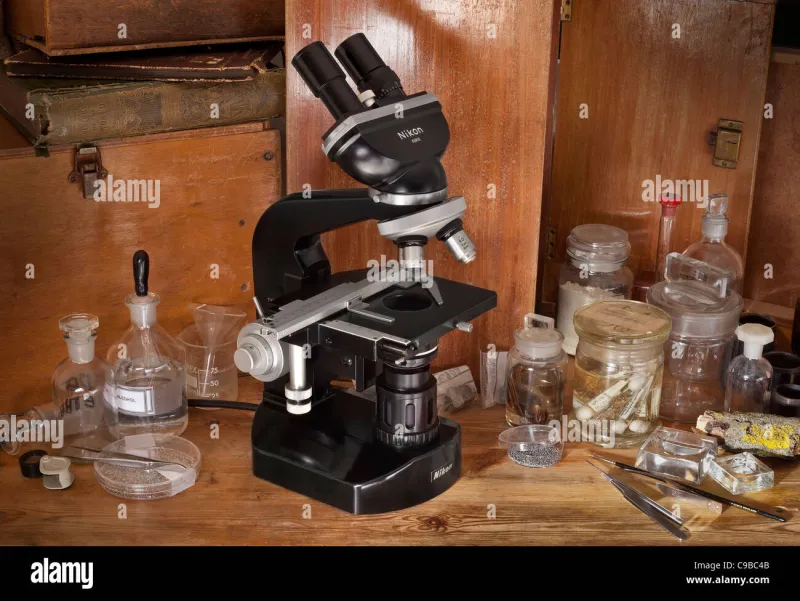
Photo: vintage laboratory petri dishes scientific research 1920s microscope, via c8.alamy.com
The Most Important Mess in History
Alexander Fleming was not, by most accounts, a tidy man. His laboratory at St. Mary's Hospital in London was the kind of workspace that would make a modern safety inspector develop a nervous tic. Petri dishes stacked in precarious arrangements. Culture samples left out longer than protocol suggested. The general atmosphere of a room where scientific curiosity had decisively won its battle against organizational discipline.
This was, it turns out, one of the most consequential character traits in the history of medicine.
In the summer of 1928, Fleming returned from a vacation to find that one of his neglected petri dishes — left sitting out in the warm London air — had developed a contaminating mold. The mold, Penicillium notatum, had done something remarkable: it had killed the bacterial colonies growing around it, leaving a clear ring of destruction in the culture medium. Fleming recognized immediately that he was looking at something worth investigating.
That story is famous. What's less famous is how many times, and in how many ways, the whole thing nearly didn't happen.
Enter the Cleaning Staff
St. Mary's Hospital, like any medical institution, took sanitation seriously. In a setting where infectious disease was both the subject of study and a constant operational hazard, cleanliness wasn't optional — it was institutional doctrine. Lab assistants and cleaning staff worked hard to keep surfaces disinfected and cultures properly managed.
The problem was that Fleming's lab operated on a different philosophy than the cleaning schedule assumed.
Multiple accounts from colleagues and lab staff describe friction between Fleming's working style and the hospital's sanitation expectations. Cultures that looked abandoned were, from Fleming's perspective, still active experiments. Dishes that appeared ready for disposal were, in his view, still producing data. The line between a productive mess and a health hazard was, in Fleming's laboratory, drawn in a very different place than the institution would have preferred.
At least one occasion is documented — and likely more went unrecorded — where a lab assistant, acting in good faith and following reasonable hygiene protocols, disposed of or disinfected materials that Fleming considered active research. Each time, it was a small loss. The one time it might have included a certain contaminated petri dish, it would have been the loss.
The Specific Threat to the Specific Dish
The famous contaminated culture didn't survive by accident. It survived because Fleming was in the habit of letting things sit, which meant dishes were left in places and for durations that a more structured lab wouldn't have permitted — and which made the specific environmental conditions that allowed the mold to grow possible in the first place.
Scientists who have studied the discovery note that the contamination almost certainly occurred during a period when the lab was relatively quiet, temperatures were unusually cool for summer (which slowed bacterial growth and gave the mold time to establish itself), and the dish had been left in a location that wasn't part of the regular cleaning rotation.
In other words: the mess saved it. A cleaner lab would have had the dish in an incubator or disposal queue. A more attentive cleaning schedule might have caught it during the window when the mold was still establishing. A more organized Fleming might have noticed the contamination earlier and discarded it as a ruined experiment rather than examining it.
The discovery required, almost as a prerequisite, a laboratory that was specifically not operating the way laboratories were supposed to operate.
What This Says About How Science Actually Works
The official story of scientific progress tends to look clean in retrospect. A brilliant mind, a controlled experiment, a discovery, an application. The reality is almost always messier — sometimes literally.
Penicillin's origin story is a useful corrective to the idea that scientific breakthroughs are the product of rigorous process alone. Fleming's lab was, by institutional standards, a problem. His habits were tolerated rather than encouraged. The contamination that led to the discovery was, from any reasonable perspective, a failure of laboratory discipline.
And yet.
The broader irony is that the very systems designed to produce reliable science — cleanliness, organization, protocol adherence — were the systems that most threatened this particular discovery. The mold needed disorder to find its way into that dish. It needed neglect to establish itself. It needed a scientist who looked at a ruined experiment and asked what it was doing instead of throwing it away.
A Near Miss the History Books Mostly Skip
When penicillin's discovery is taught, the emphasis is usually on Fleming's observational genius — and that emphasis is deserved. But the near-miss element of the story deserves more attention than it typically gets.
Medicine's most transformative drug — one that has saved an estimated 200 million lives since its introduction — came within the reach of a disinfectant bottle more than once before Fleming ever got to examine it. The margin between discovery and oblivion was, at various points, a lab assistant with a cloth, a cleaning schedule written by someone who'd never met Alexander Fleming, and the institutional assumption that a tidy lab was a productive one.
Sometimes the most important thing a scientist can do is leave the dishes.